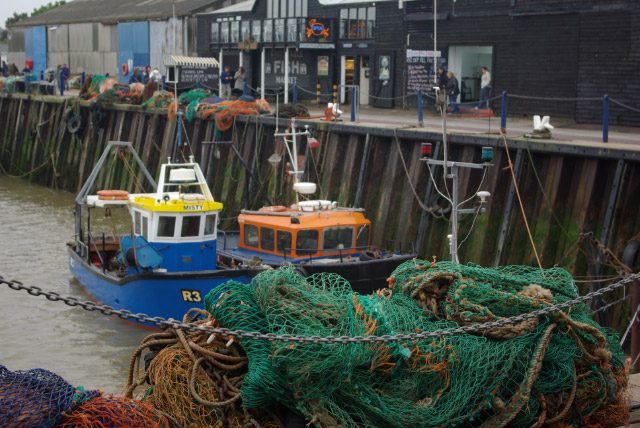
A harbour town, not a postcard
Whitstable made its name on oysters. Romans were packing them for the journey home; by the 1790s the
Company of Free Fishers and Dredgers had organised the beds that still sit offshore. The Whitstable Oyster
Fishery Company carries that line today. Come summer, the Oyster Festival still lands the catch and blesses
the waters — half ceremony, half excuse for mud and music.
The harbour you walk now was built in 1832 to serve the Canterbury and Whitstable Railway, one of the earliest
steam passenger lines, nicknamed the Crab and Winkle for the seafood that paid the bills. Coal came in by
collier; visitors followed; fishing and shipbuilding kept the quay honest. Fishing never quite left. Neither did the lore. The railway is a cycle path now.
The harbour still works.
Local lore stays close to the shingle. The Old Neptune — the Neppy — sits on the beach at Island Wall, rebuilt
after the sea had opinions. Nearby, Dollar Row cottages were raised on the proceeds of salvaging a ship that
carried silver dollars. The Favourite, an 1890 oyster yawl, is one of the last of her kind and still a reminder
of a fleet that once numbered around a hundred and fifty. None of that needs inventing. It is already on the wall.
Writers found the place whether they loved it or not. W. Somerset Maugham spent a difficult childhood here with
his uncle, the vicar of All Saints; Whitstable becomes “Blackstable” in Of Human Bondage and
Cakes and Ale. Sarah Waters lived on the beach at Seasalter as a Kent student and has said that time
partly fed her debut, Tipping the Velvet — whose narrator, Nancy Astley, is a Whitstable oyster-girl
before London. Julie Wassmer set her Pearl mysteries on this quay; Katherine May writes from the town and swims
the same stretch. WhitLit keeps the bookshelf noisy.
Cameras like the light. The BBC’s Tipping the Velvet (2002) shot Nan’s coastal home here; Roger Michell’s
Venus (2006) brought Peter O’Toole to the Old Neptune, the beach and the station for a last paddle
(and an Oscar nomination). Acorn’s Whitstable Pearl still films along the harbour, Tankerton Beach and
the Neppy. Long before the drama vans, Peter Cushing lived in Whitstable for some thirty-five years — Hammer,
Star Wars, and a neighbour who walked Island Wall like anyone else. He called it the village.
It is a good place to visit and a better one to live. Come for oysters and Tankerton huts; stay because the trains
work, the water is still worked, and neighbours still know who turned up. Visitors get the working harbour, native oysters, Horsebridge
rooms, and Tankerton’s slopes and huts without needing a brochure voice. Residents get the same sea plus a town
that still talks to itself: Friday markets, trades who turn up, a High Street that is not only chains, and trains
that make London a commute rather than a relocation. CT5 is Whitstable, Tankerton, Swalecliffe, Chestfield and
Seasalter — five neighbourhoods, one foreshore habit. Come look. Pin something if you live here.
Seawall does not replace any of it. It pins up the modern clutter: Harbour Market times, a missing tabby on
Tankerton Slopes, the trades tip that saves a deposit. Residents first. Visitors welcome to look.